

How to Read a Supplement Label: The Nutrition Facts Panel
A practical guide for pharmacists and shoppers: serving size, percentages and the ** symbol, units, ingredients, storage and shelf life, using the Dawaak boxes.
In this article
- What is the nutrition facts panel on a supplement?
- Serving size or daily dose: what is the difference?
- How to read the amount per serving
- mg, mcg or IU? The units on the label
- What does RDA% mean?
- What does “**” mean on a nutrition facts panel?
- Active and inactive ingredients
- Precautions, storage and shelf life
- Where do I find the registration number?
- A quick checklist before listing a supplement
- Want to stock Dawaak in your pharmacy?
- Frequently asked questions
- Sources
Reading a supplement label starts with two lines at the top of the nutrition facts panel: the serving size and the number of servings per container. Below them comes the amount of each active ingredient per serving, then a percentage that compares that amount with a daily reference value, and then the footnotes that explain symbols such as “*” and “**”. Outside the panel you will find the active and inactive ingredients, directions for use, precautions, storage conditions and shelf life. This guide walks through each part in order, using the four Dawaak boxes as worked examples with their printed wording. It is written for pharmacists checking a product before dispensing or listing it, and for anyone comparing two boxes on a shelf.
What is the nutrition facts panel on a supplement?
The nutrition facts panel is the part of the label that states how much of each substance a serving contains. On Dawaak boxes it has three parts:
- Nutritive values: calories, fat, carbohydrate, protein and sodium, per 100 g and per serving.
- Active ingredients (with RDA%) per serving: ingredients that carry a percentage, such as calcium, zinc and vitamin D3.
- Active ingredients (with DV not established) per serving: ingredients with no daily reference value, shown with “**” instead of a percentage. This section appears on the OmeCare box.
Under the panel come the footnotes, then the rest of the label: ingredients, directions, storage, precautions, shelf life and manufacturer details.
Serving size or daily dose: what is the difference?
The serving size is the quantity the panel’s figures are calculated on. The directions are what the box advises per day. They often match, but not always, so read both lines together.
| Product | Serving size in the panel | Servings per container | Directions on the box |
|---|---|---|---|
| Vita One | 1 capsule (1.1 g) | 30 | For Adults: 1 Capsule daily or as recommended by a Physician. |
| Cal K | 2 film-coated tablets (2.8 g) | 15 | For Adults: One Film Coated Tablet daily or as recommended by a Physician. |
| Ferro B | 1 capsule (0.4 g) | 30 | For Adults: 1 Capsule daily or as recommended by a Physician. |
| OmeCare | 1 soft capsule (1.5 g) | 30 | For Adults: 1 Soft capsule daily or as recommended by a Physician. |
The Cal K example: a 2-tablet serving and 1-tablet directions
The Cal K panel is calculated on a serving of two film-coated tablets. The box holds 30 tablets, so that is 15 servings. The directions, however, are one film-coated tablet daily or as recommended by a physician. So the figures in the panel, such as 500 mg calcium, refer to the two tablets together, exactly as printed. To answer “how much is in one tablet?” or “how long does a box last?”, read both lines; the doctor decides the right amount for each person.

On the box · Cal K
Product page →“Serving Size (2.8 gm) 2 Film coated Tablets” · “Servings Per Container 15”
“For Adults: One Film Coated Tablet daily or as recommended by a Physician.”
How to read the amount per serving
Each ingredient has a number and a unit. That number is the amount of the nutrient itself in a serving, not the weight of the compound it comes from. Cal K’s active ingredients list “Calcium (Calcium Carbonate)”, and the panel figure, 500 mg, is the calcium.
The Cal K panel as printed:
| Ingredient | Per serving (2 film-coated tablets) | RDA% |
|---|---|---|
| Calcium | 500 mg | 50% |
| Magnesium | 50 mg | 16% |
| Potassium | 40 mg | 2% |
| Zinc | 30 mg | 214% |
| Vitamin D3 | 10 mcg | 67% |
mg, mcg or IU? The units on the label
Three units appear on Dawaak boxes:
- mg (milligram): one thousandth of a gram.
- mcg (microgram, sometimes written µg): one thousandth of a milligram. So 1 mg = 1,000 mcg, and 400 mcg = 0.4 mg.
- IU (international unit): a unit whose weight differs from one vitamin to another, so there is no single conversion factor.
OmeCare is a useful example because it prints both units:
- “Vitamin D3 (400 IU)” at 10 mcg. That matches the NHS conversion: 1 microgram of vitamin D equals 40 IU.
- “Vitamin E (15 IU)” at 6.75 mg. Here 15 IU of vitamin E is expressed in milligrams, not micrograms.
The rule: compare like with like. The 10 mcg of vitamin D3 in Vita One is the same amount OmeCare labels “400 IU”. For more on vitamin D, see our guide to vitamin D3 in the four Dawaak products.
What does RDA% mean?
The percentage next to each ingredient compares the amount per serving with a daily reference value. MedlinePlus, from the US National Library of Medicine, defines the Recommended Dietary Allowance (RDA) as the average daily intake that is enough to meet the nutrient needs of nearly all (97% to 98%) healthy people. The US FDA’s supplement labeling guide explains that the percentage is calculated by dividing the amount by the Daily Value and multiplying by 100, rounded to the nearest whole percent.
A worked example from the boxes: vitamin D3 is shown as 67% at 10 mcg on Vita One, Cal K and OmeCare, and 33% at 5 mcg on Ferro B. By our arithmetic, that is consistent with a reference of 15 mcg, which is the RDA MedlinePlus gives for adults aged 19 to 70. The box does not name its reference, and reference values differ between authorities and countries.
What does a figure above 100% mean?
Some ingredients exceed 100%: zinc at 214% on Cal K, iron at 136% on Ferro B, vitamin K2 at 150% on Vita One. It means the serving contains more than the reference value used in the calculation. The percentage is not a safety limit; upper limits are separate figures that health authorities set for each nutrient. That is why all four boxes carry the same line: “Do not exceed the recommended daily dose.”
And the “*” footnote?
Under all four panels, not only Cal K and OmeCare: “The Percent of Daily Values are based on a 2000 calories diet. Your Daily Values may be higher or lower depending on your calorie need.” It applies to the percentages in the nutritive values section (calories, fat, carbohydrate).
What does “**” mean on a nutrition facts panel?
“**” means the ingredient has no daily reference value, so no percentage can be calculated. The OmeCare footnote reads: “** Daily Value not established.” The Arabic line on the same box reads «** القيمة اليومية غير متأسسة.» (as printed). The FDA uses the same convention: ingredients without a Daily Value are marked with a symbol in the % column that refers to the footnote “Daily Value Not Established”.
The OmeCare active ingredients as printed:
| Ingredient | Per serving (1 soft capsule) | RDA% |
|---|---|---|
| Vitamin E (15 IU) | 6.75 mg | 75% |
| Vitamin D3 (400 IU) | 10 mcg | 67% |
| Omega-3 Fish Oil | 1000 mg | ** |
| Eicosapentaenoic acid (EPA) | 350 mg | ** |
| Docosahexaenoic acid (DHA) | 200 mg | ** |
Note that EPA and DHA are part of the 1,000 mg of fish oil, not an amount added on top.
Active and inactive ingredients
Active ingredients are what the product is made for, usually with the chemical form in brackets. Ferro B, for example, lists “Iron (Ferrous Fumarate)” and “Vitamin B12 (Cyanocobalamin)”.
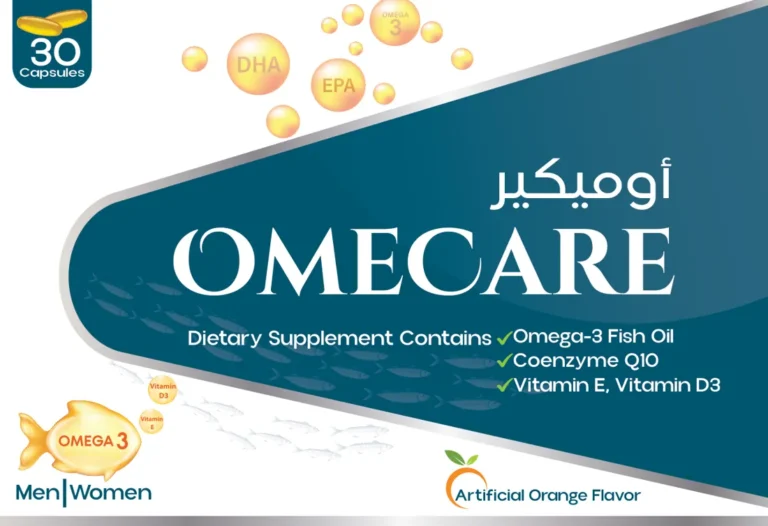
Inactive ingredients are manufacturing materials, listed on Dawaak boxes with their E-code and function. OmeCare: “Glycerol – E422 – Humectant, Artificial Orange Flavor, Bovine Gelatin (Capsule Shell).” This is the line to check when someone asks about the capsule shell or the flavour.
An ingredient with no row in the panel: the CoQ10 example
OmeCare’s active ingredients read: “Omega-3 Fish Oil, Coenzyme Q10 Powder 10%, Vitamin E (dl-alpha-Tocopheryl Acetate), Vitamin D3 (Cholecalciferol).” The nutrition facts panel has no row for coenzyme Q10, so no amount per serving is stated. The “10%” in the ingredients list describes the coenzyme Q10 powder as written; it is a percentage, not an amount in milligrams. If someone asks “how much CoQ10 is in each capsule?”, the accurate answer is that the box does not state it.
Precautions, storage and shelf life
Precautions
All four boxes share two lines: “Consult your doctor before use” and “Do not exceed the recommended daily dose.” Each product also has its own, for example:
- Vita One: “Consult a health care provider / doctor prior to use if you are taking blood thinners.”
- OmeCare: “This product contains Fish Oil.”
- Ferro B: “To obtain the desired benefit, 400 micrograms of Folic acid supplement should be consumed daily for a month before the start of pregnancy and at least three months after.”
Storage
All four boxes: “Keep out of sunlight, at a temperature below 25°C, in a cool dry place.” and “Keep away from the reach of children.” This applies to the pharmacy shelf and the stockroom as much as to the home.
Shelf life and expiry date
The shelf life printed on Dawaak boxes is 24 months. Shelf life is not the same as the expiry date: the first is the product’s life from manufacture, the second is a specific date for the batch in your hand. Check the expiry date and batch number printed on the pack before dispensing or receiving stock, and rotate the shelf so the earliest expiry goes out first.
Where do I find the registration number?
All four Dawaak products are registered with the Saudi Food and Drug Authority. The registration number is not printed on current Dawaak boxes; it is on each product page and at the end of this article, and we send it in writing with the quote. For any other product you handle, ask the supplier for the registration number in writing before listing it.
A registration number identifies the product. It does not mean the authority promotes or recommends it.
A quick checklist before listing a supplement
- Serving size and servings per container, compared with the directions.
- The amount and unit of each ingredient, converted where needed (mg, mcg, IU).
- The percentages, and any ingredient marked “**”.
- Any active ingredient listed without a row in the panel.
- Inactive ingredients, especially the capsule shell and flavour.
- Product-specific precautions, such as blood thinners or fish oil.
- Storage conditions, expiry date, batch number and registration number.
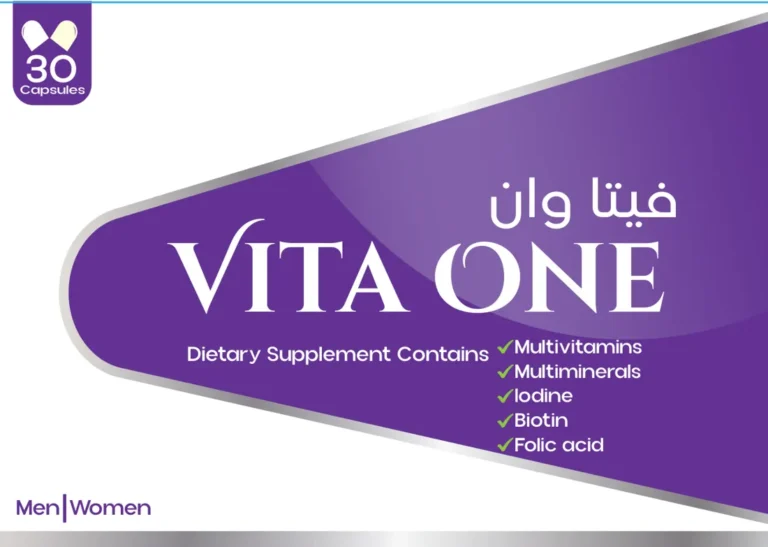
- Overlap between supplements: vitamin D3 is in all four Dawaak products, and iron and folic acid are in both Vita One and Ferro B. Amounts add up.
Want to stock Dawaak in your pharmacy?
All four Dawaak products are made in Saudi Arabia, with their panels and registration numbers published on the product pages. There is no minimum order: buy by the box or by the carton, with delivery to all regions of Saudi Arabia. Send your request through For pharmacies and businesses or to info@dawaak.com, and we contact you within 2 to 24 hours and send you a written quote.
Frequently asked questions
What does ** mean on a nutrition facts panel?
It means the ingredient has no daily reference value, so no percentage is shown. The OmeCare footnote reads “** Daily Value not established.”, and the FDA uses the same convention on supplement labels.
What is the difference between mg and mcg?
A microgram (mcg) is one thousandth of a milligram (mg). So 1 mg = 1,000 mcg, and 400 mcg = 0.4 mg.
Why is the Cal K serving 2 tablets when the directions say 1?
The panel is calculated on a serving of two film-coated tablets (15 servings per box), while the directions read “For Adults: One Film Coated Tablet daily or as recommended by a Physician.” The panel figures refer to the two tablets together; your doctor decides the amount for you.
How many IU are in a microgram?
It depends on the vitamin. For vitamin D, 1 mcg = 40 IU (NHS), which is why OmeCare shows “Vitamin D3 (400 IU)” next to 10 mcg. For vitamin E, OmeCare shows “15 IU” next to 6.75 mg.
What is the difference between active and inactive ingredients?
Active ingredients are what the product is made for, such as calcium or vitamin D3. Inactive ingredients are manufacturing materials with a stated function, such as “Bulking Agent”, “Stabilizer” or “Capsule Shell”.
Sources
Show the sources (5)
- MedlinePlus (US National Library of Medicine): Vitamins (definition of RDA)
- MedlinePlus: Vitamin D (adult RDA)
- NHS: Vitamin D (micrograms and IU)
- US FDA: Dietary Supplement Labeling Guide, Chapter IV: Nutrition Labeling
- Box text and nutrition facts panels of Vita One, Cal K, Ferro B and OmeCare.
Registration numbers: Vita One FOP-240226-74229 · Cal K FOP-120226-60037 · Ferro B FOP-120226-60009 · OmeCare FOP-100226-55838.
Food supplements are not a substitute for a balanced diet and a healthy lifestyle. Use after consulting a doctor, and do not exceed the recommended daily dose.
Keep reading
More articles
 Ingredients
Omega-3 Benefits: What Are EPA and DHA, and How Do You Read a Fish-Oil Label?
What EFSA and MedlinePlus say about EPA and DHA, and why 1000 mg on the front is not the omega-3 amount. A…
 For pharmacies
Choosing a Supplement Supplier: A Checklist for Pharmacies
Eight questions a pharmacy, chain or distributor should ask any supplement supplier before the first order, from registration numbers to quote speed,…
 Ingredients
Iron Tablets in Pregnancy: What Health Bodies Say, and What the Box Says
Pregnancy needs 27 mg of iron a day according to the Saudi MOH, and WHO recommends a daily iron and folic acid…